Practical Secrets to Help Newbies Run Effective Ads Right From the Start
Thu Huyen
532 views
Table of Contents
Running Facebook Ads is not as simple as launching a campaign and waiting for orders to come in. In fact, most newbies end up wasting money without seeing results because they have not yet grasped the core formula for optimization.
The secret lies in three fundamental elements: Product - Content - Goal. The product is the foundation, the content is the key to attract customers, and the main goal is the compass to keep you from going astray. When you combine these three elements correctly, you will optimize your budget, attract leads consistently, and build a sustainable sales system.
The product is the foundation
The product is the “heart” of every advertising campaign. You can optimize your targeting, write creative content, or run a huge budget, but if the product isn't attractive enough, it's all just a waste of money.
A product with a Unique Selling Point will create a significant advantage:
- Customers will proactively seek it out, significantly reducing advertising costs.
- Conversion rates are much higher than with mass-produced products.
- The budget can be easily expanded without the bid price increasing too quickly.
-
- Analysis Product analysis: What problem does it solve? What are its differentiating features from competitors? Why would customers choose you over others?
- Focus on products that are in high demand in the market, resonate with consumer emotions (beauty, health, family…), and have a sufficiently high profit margin to sustain advertising.
- Show the biggest benefit of the product (USP) in the first few seconds.
- Or evoke a pain point or problem that the customer is facing to draw them in.
- Large Budget (10–20 million+): Broad target so that machine learning algorithms can find potential customers.
- Medium Budget (1–2 million): Narrower target by gender, age, or geographic location.
- Small Budget (<1 million): Should only run for niche products and target very precisely.
- General products → broad target, for algorithm optimization.
- Specialized products (real estate, functional foods, courses…) → scan UIDs from relevant groups/fanpages or run Custom Audiences from email, phone number.
- Don't go all-in on one ad group; always split it up for testing.
- Don't increase the budget suddenly (only increase by a maximum of 20% with a large budget, or double with a small budget).
- Always allocate 10–20% of the budget to A/B testing.
- Ensure a minimum budget for machine learning to have sufficient data (≥50k/day).
- Scale ads based on real data, not on intuition.
Want to understand more about how to identify the right "differentiating point" of your product and exploit it in your advertising content? You can see more here: Top 3 Facebook Ad Content Mistakes That Waste Your Budget
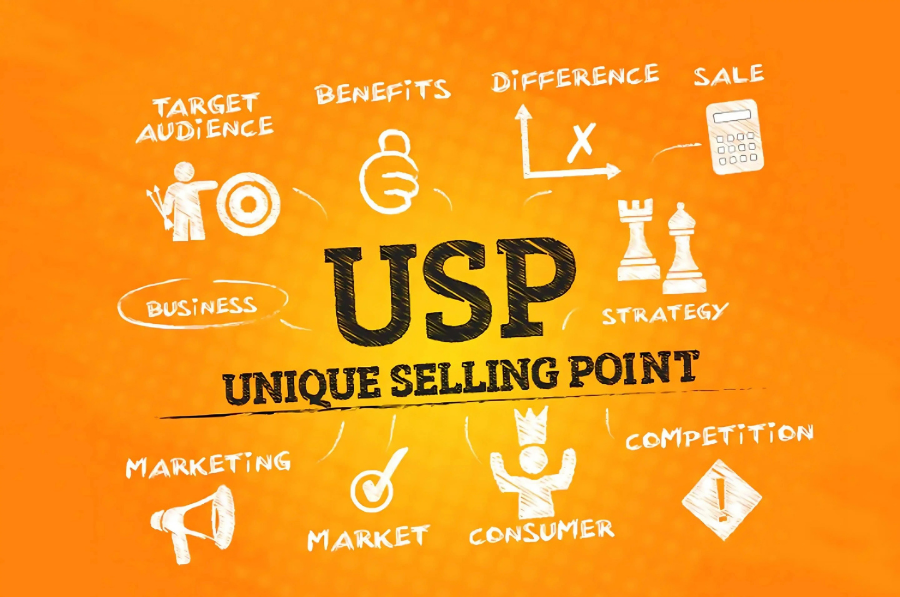
USP - Unique Selling Point
Actions to take:
For example: when the “healthy lifestyle” trend rose, products like mini blenders or insulated water bottles exploded with orders, simply because they met the right needs, at the right time, and solved consumer pain points.
Content is the soul
Ads on Facebook or any platform only have the first few seconds to determine success or failure. If you don't make an immediate impression, you're practically "throwing money away."
1. Images
An effective image needs to have three elements: beautiful, concise, and clear messaging.
Limit text on the image to avoid visual clutter, and apply the familiar 20% text rule.
Call-to-action (CTA) buttons should use warm colors like red, orange, or yellow to stand out.
And most importantly: always adhere to the advertising policy - avoid using offensive, negative, or exaggerated images of the product's benefits.
2. Video
Video is the most powerful "weapon" if you know how to use it. In just the first 15 seconds, viewers will decide whether to stay or skip over.
There are two common hook formulas:
For example: a clip selling an English course only needs to start with a scene of "students communicating fluently after 3 months" to double the watch rate compared to a long introductory video.
3. Title & Copy
The title should be concise and focus on the core benefit the customer receives.
Don't forget to include a clear CTA such as "Register Now," "Get Today's Offer," or "Inbox for Consultation."
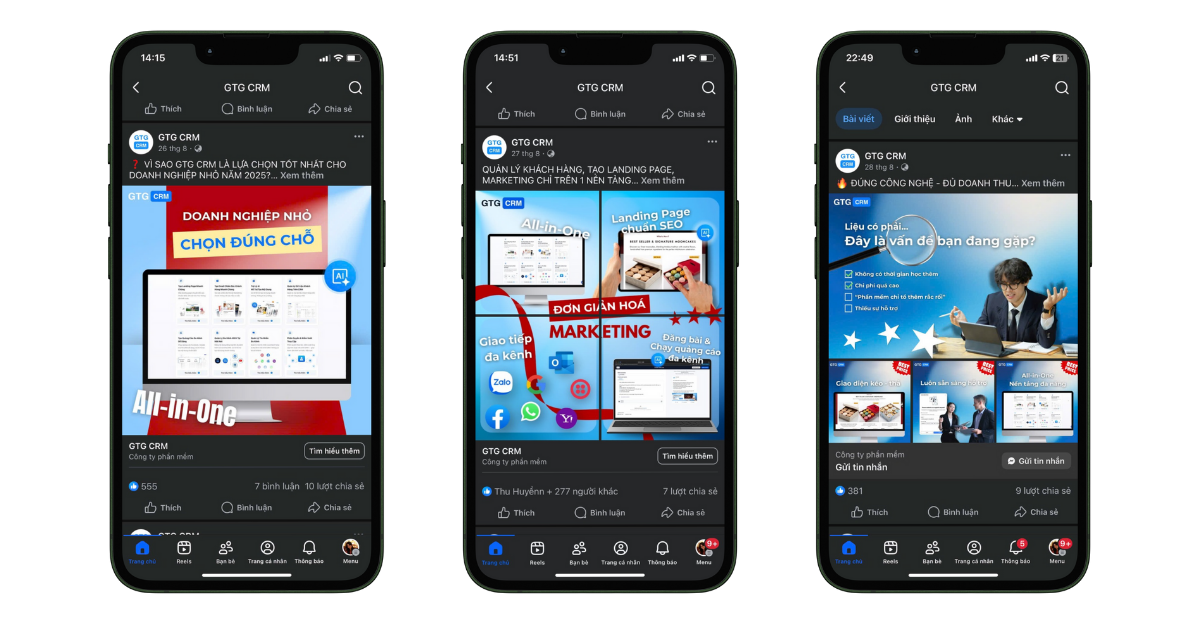
GTG CRM's Facebook Ad Content
The goal is the guiding principle
In advertising, choosing the wrong goal is like burning money.
Each goal will make one metric cheaper, but it can lead to other metrics increasing.
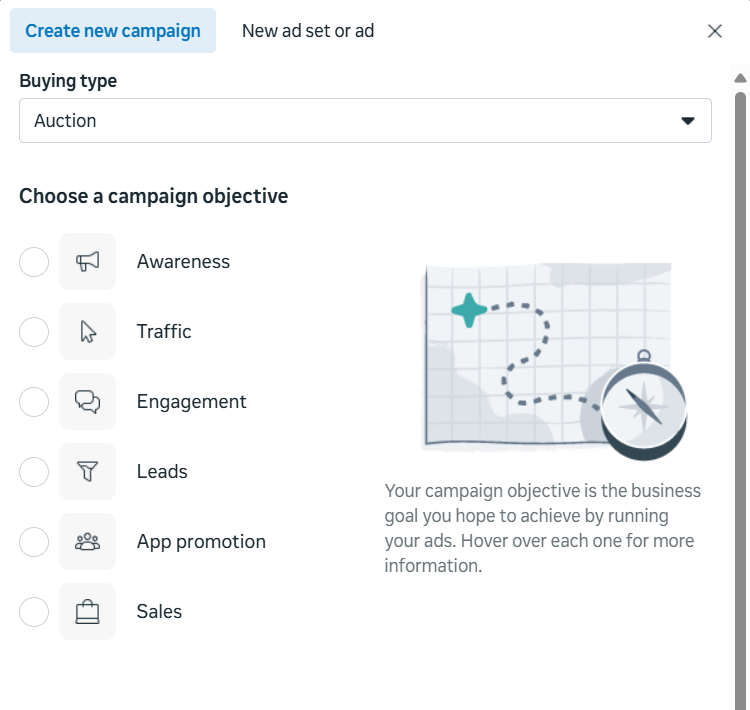
The goals of a Facebook advertising campaign
Example: if you choose the goal "Likes" If you choose a low-cost CPM, the cost will be cheaper, but the conversion rate is usually very low. Conversely, if you choose a Conversion goal, the cost may be higher, but it's easier to generate orders.
The principle here is: don't be tempted by cheap options, choose a goal directly linked to the KPIs that the campaign is aiming for.
To understand each goal better and choose more accurately, see below: Popular Facebook Ads Goals to Increase Conversions and Sales
Optimizing Facebook Ads Strategies for Beginners
Step 1: Determine the Budget
Example: With a small budget for a local brand fashion product, narrow targeting to the 18–25 age group in major cities is often more effective than broad targeting. national.
Step 2: Target the right audience
Note: don't cram too many interests into one target group. The more "mixed," the harder it is for machine learning to optimize.
Step 3: Implement content & A/B testing
Prepare at least 2–3 different samples: you can change the image, change the copy, or change the CTA.
Run them in parallel to find the "winning" content.
Step 4: Set multiple small ad groups
Don't put your entire budget into one large group.
Instead, create several small groups (50k–200k/day).
After 24–48 hours, scale the effective group and turn off the failing group.
In practice: Two identical setups can still produce completely different results.
Step 5: Monitor & Re-optimize
Every 24 hours, carefully review the data: CPC, CTR, CPM, ROAS…
If ads start increasing in price after a few days, clone a new campaign instead of trying to force it.
Golden Principles When Optimizing Ad Budgets
Overall: product, content, target audience, budget, and conversions must all be synchronized.
Conclusion
Facebook Ads are only effective when combining the right product - content - goals with a clear strategy. By doing this, you will save costs and increase orders sustainably.
Don't let your budget go to waste. Apply this formula to your next campaign, or experience GTG CRM to optimize content, manage data, and run ads more effectively all in one platform.
Maybe You Should Read These

Update new consumption trends in Vietnam in the period 2025 - 2030

Optimize every touchpoint on the customer journey with GTG CRM's Omnichannel Messaging
Popular Facebook Ad Objectives to Increase Conversions and Sales

Create SEO-standard Landing Page to attract potential customers with GTG CRM

08 Important KPIs when promoting on Social Networks