Google Ads Recommendations: When to Listen, When to Ignore
Thanh Tra
532 views
Table of Contents
If you are a Google Ads advertiser, you are probably familiar with the Recommendations section. Google offers automated suggestions to help you optimize your account. But are all these suggestions good?
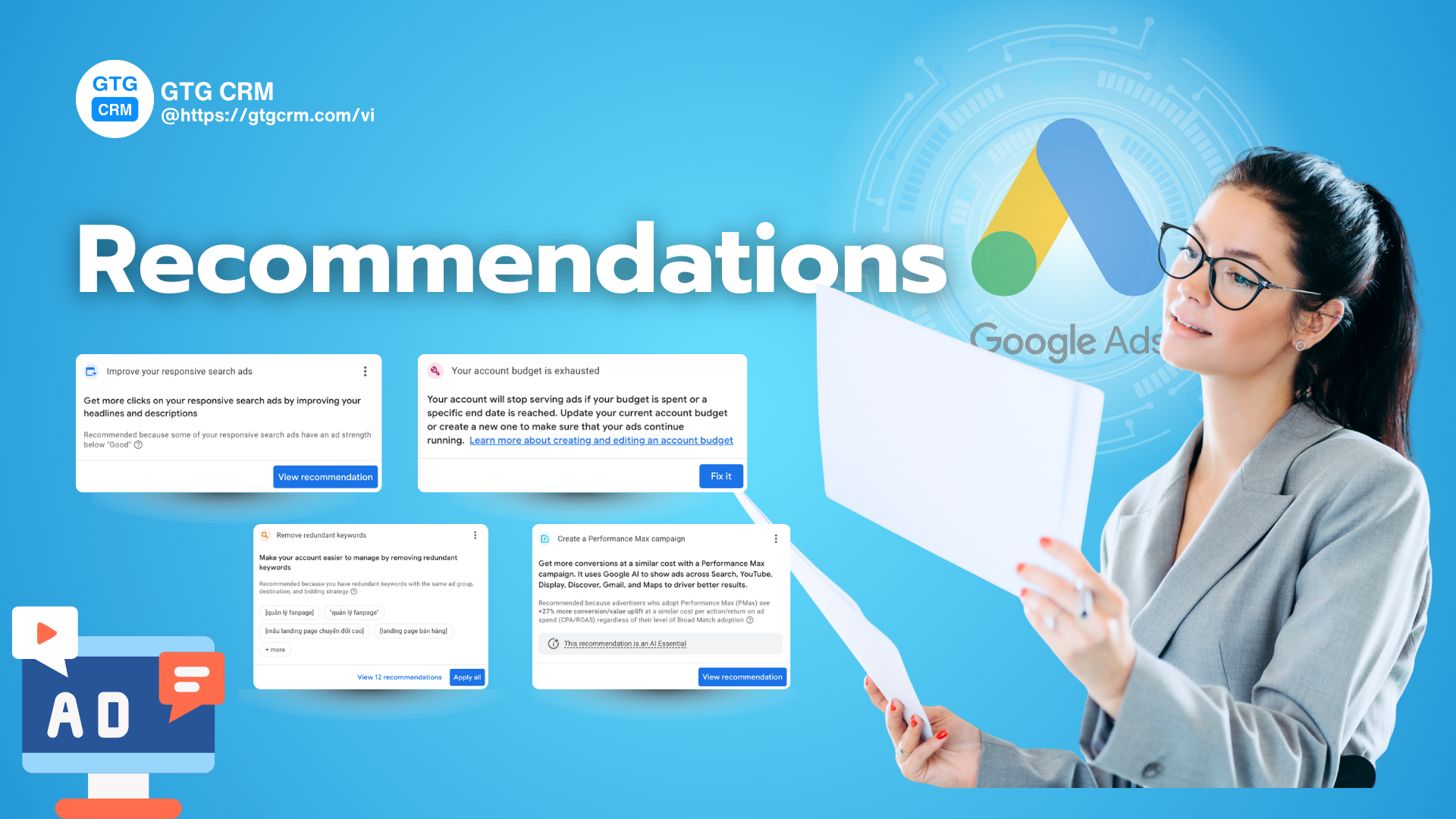
Google Ads Recommendations
Some recommendations are remarkably effective, while others can seriously harm your campaign performance. This article will help you become a smart advertiser, categorizing Google Ads suggestions into three distinct groups: Ignore,Evaluate, And Use.
Suggestions you should carefully consider
These are suggestions with a high risk of harm, often not taking into account your specific
business context. Applying them blindly can lead to
"burning" advertising money.
Optimizing Your Budget
Why should you consider it?
- Inaccuracy: Google may be good at algorithms, but their budget suggestions are often unrealistic. For example, a proposal to increase the weekly budget in exchange for more conversions might look appealing, but often leads to a significant decrease in ROAS (Return on Advertising Spend) or a 2-10 fold increase in CPA (Cost Per Conversion).
- Ignoring Profitability: This proposal doesn't care about your profit, but focuses only on consuming the budget and generating more conversions, regardless of the cost.
-
- Risk of budget waste: Broad Match is a powerful but also risky tool. Adding broad match without carefully evaluating your account can cause your ads to show for irrelevant queries, increasing costs and decreasing performance.
- Not always suitable: Broad Match should only be used when you have good control over other match types, and your bidding strategy has been optimized to handle this keyword type.
- Unwanted Performance Max (PMax) Priority: At first glance, removing duplicate keywords seems logical. However, doing this can cause Google to automatically prioritize campaigns with Performance Max over your Search Campaigns.
- Reduced Conversion Rate: Search campaigns typically deliver higher conversion rates than PMax. Therefore, applying this suggestion may reduce the total number of conversions you receive, harming the overall performance of your account.
- Helps detect errors: Keyword conflicts occur when a negative keyword of yours accidentally blocks a target keyword from appearing. This is a common mistake and always worth fixing.
- Fixing the error isn't simply deleting: You need to analyze to decide whether to delete the negative keyword or pause the main keyword, depending on the campaign goal.
- Improve Ad Strength: Although the "Ad Strength" metric may not be everything , this suggestion often indicates that your ads lack diversity.
- Increase CTR and conversion rate: This suggestion often indicates that you have too many titles related to keywords and lack important elements. such as:
- Strong calls to action (CTAs).
- Outstanding unique selling points (USPs).
- Clear benefit statement.
- Add ad extensions: Extensions make your ads stand out more, take up more space on the search page and provide more information to users, thereby improving CTR and quality.
- Add new keywords: This suggestion is usually based on actual search data that Google collects helps you discover potential keywords that can bring more traffic and conversions.
- Pause high-cost keywords that don't convert: This is a very useful suggestion, helping you eliminate keywords that waste budget and focus on more effective keywords.
- Track actual ROI (Return on Investment): You can see how many leads and successful orders a proposal to increase budget or add new keywords has brought in.
- Evaluate keyword performance: GTG CRM Helps you know exactly which keywords are bringing in quality customers, so you can be more confident when deciding to add or remove a keyword.
Remember, advertising budgets should be decided based on business goals and profitability, not from an automated proposal.
Add Broad Match Keywords
Why you should consider Reminder?
If you are experiencing high Impression Share due to a large budget, adding broad match may worsen the situation. Decide to use broad match based on actual performance and budget, not because of an automated suggestion.
Remove Duplicate Keywords
Why should you consider this?
Suggestions you should apply for advertising
These suggestions provide in-depth information and require you to check your account more thoroughly. They aren't always right, but it's worth your time to analyze.
Remove Conflicting Negative Keywords
Why should you evaluate?
While Google may not be entirely accurate, this suggestion is a useful warning. Checking and resolving these conflicts will help you ensure your ads always display correctly for important keywords.
Make Your Titles and Descriptions More Unique
Why should you evaluate?
When you see this suggestion, reconsider your ad headlines. If you have too many different keywords in one ad group, consider splitting the group so that each ad group focuses on a single topic, making the titles more relevant and increasing effectiveness.
Recommended Suggestions
These are simple suggestions, often related to missing elements and almost always beneficial when applied.
GTG CRM: Optimize Google Ads Suggestions, Increase Real Sales
GTG CRM's AI doesn't give "generic" suggestions. Instead, it provides actual data to help you make the best decisions, focusing on the ultimate profit.
Proposal Effectiveness Analysis Based on Business Data
Instead of relying on Google's estimated numbers, GTG CRM helps you:
Support for Instant Optimization Decision Making
GTG CRM Provides visual reports, helping you quickly, detect wasteful keywords, identify keywords that consume a lot of budget but don't generate revenue.
With GTG CRM, you no longer have to guess. Every optimization decision is based on real business data, helping you focus on what truly delivers results and turn advertising into a sustainable growth driver for your business.
Conclusion
Google Ads suggestions are like a double-edged sword. They can save you time and optimize your account, but they can also cause unforeseen losses.
Google is a powerful tool, but you are the one controlling your campaign. By understanding the nature of each type of proposal and using a tool like GTG CRM to track actual performance, you'll be able to make smart decisions, optimize performance, and ensure every dollar spent on advertising yields the highest possible return.
Maybe You Should Read These
Everything About Zalo OA: Instructions for Registering an Official Business Account from A to Z

7 steps to create a detailed Digital Marketing plan from A-Z

The secret to building a SEO-standard Website/Landing Page: A solid foundation for every Digital Marketing campaign

Discover 5 effective marketing strategies for small businesses to increase sales

GTG CRM - Comprehensive Marketing Platform to Boost Sales for Small Businesses