6 Bidding Strategies in Google Ads
Thanh Tra
532 views
Table of Contents
You may have the right keywords, a great ad copy, and a perfect landing page, but if you choose the wrong bidding strategy, your entire budget will go astray. In reality, many small and medium-sized businesses face the same pain point: They don't know whether to choose manual or automated methods, whether to optimize by clicks, conversions or value?
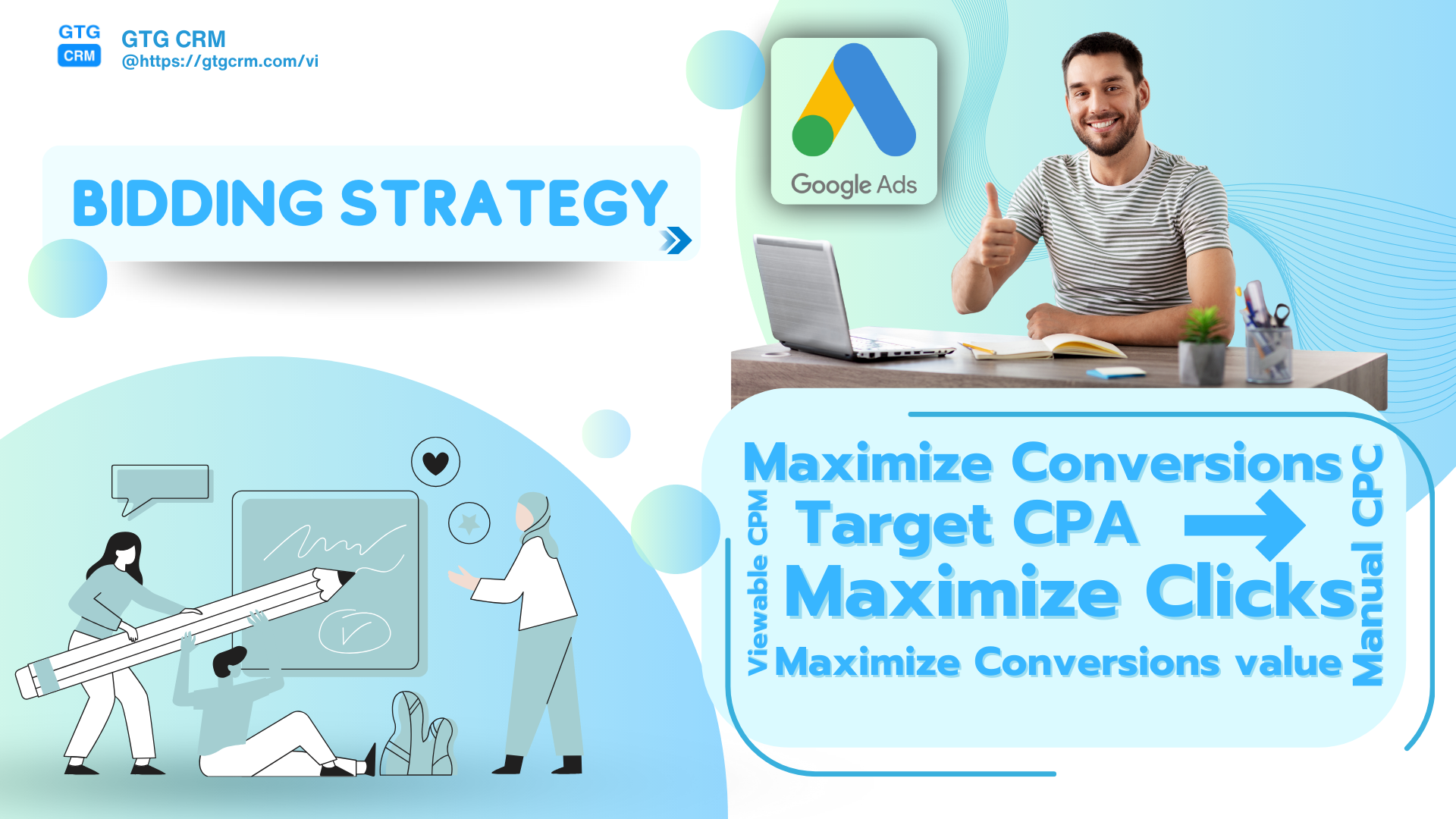
Bidding Strategies in Google Ads
In this article, we will analyze the 6 most popular bidding strategies, and explain the differences between Standard Bidding and Portfolio Bidding, and how GTG CRM This helps transform lead data into optimal budget decisions.
Standard Bidding vs Portfolio Bidding
- Standard Bidding: You choose a separate bidding strategy for each campaign. For example, a Search Ads campaign runs Target CPA, a Display Ads campaign runs Maximize Clicks. This is the traditional way, suitable if each campaign has different goals and you want to control them separately.
- Portfolio Bidding: You create a “strategy portfolio” that applies to multiple campaigns, ad groups or keywords at the same time. The advantage is that Google has more aggregated data from the entire portfolio to optimize more intelligently. A portfolio also saves management time if you have multiple campaigns with a common goal (for example, all lead generation campaigns are running with a Target CPA of 200,000 VND).
Small businesses often let each campaign choose a different bidding process, leading to fragmented data. Portfolios allow for data consolidation and focused optimization, but are difficult to manage without a system to track lead quality from multiple sources. This is where GTG CRM comes into play – Gathering all lead data from multiple campaigns to analyze actual effectiveness, From there you know whether to choose Standard or Portfolio.
Target CPA – Focusing on cost per conversion
Many marketers are obsessed with the question: “How much is a real lead worth?”. Target CPA allows you to set this number and let Google automatically optimize the bid in each auction.
Advantages:
- Directly focuses on cost/lead, Easy to budget and scale, a lifesaver for those who don't want to "chase after clicks".
- Auction by auction-time: Leverages device signals, location, history… to lower CPA.
- Requires sufficiently large and clean conversion data.
- Setting CPA too low will result in no ad delivery, while setting it too high will overspend the budget and lead generation may not necessarily be of high quality.
- Optimize for easy but low-quality conversions if the targeting is wrong (micro-conversions, duplicates, spam).
- Fast traffic growth, Suitable for the data creation and keyword/ad testing phase.
- Simple setup, Does not require much conversion data initially.
- No quality guarantee: CTR may be high but low lead/poor relevance.
- Easy Burning money on broad queries If not including negatives, limit CPC, filter audiences.
- Google automatically hunts auctions with a high conversion probability, increasing number of conversions.
- Suitable for lead generation/form submission, shortens learning time compared to Target CPA when data is limited.
- Optimization for the wrong target if tracking is not accurate (half-hearted registrations, button clicks, pageviews, etc.).
- CPA can fluctuate: if micro-conversions are used as the “primary” → quality drop.
- Optimizes by value (revenue/AOV/LTV), not just quantity. Especially suitable for e-commerce, SaaS has assignment of conversion value.
- Automatic prioritization high-value customers → increased revenue/advertising revenue.
- Requires standard value tracking (GA4/CRM). Lack of value → “blind” algorithm, efficiency ≈ Max Conversions.
- Can reduce volume when prioritizing high-value transactions.
- Optimized viewable impressions (viewable impressions) → good for brand lift on Display/YouTube.
- Cost/1,000 impressions usually low, fast coverage, seeding for remarketing audience.
- Not optimized for conversions, difficult to link directly Next comes revenue (easily perceived as “image costs”).
- Need to manage frequency, brand safety, and display location to avoid wasting/obsessing users.
- Easy to implement Purposeful testing (location, equipment, time).
- Work-intensive: Difficult to maintain when the keyword list is large/dynamic.
- Easy Missed opportunities in auction-time if you react slowly; Depends on the operator's skills.
Disadvantages:
To run Target CPA effectively, the account should have at least 30–50 conversions in 30 days, a concise funnel and stable landing page so Google has enough data to optimize. Conversely, it shouldn't be applied when tracking isn't precise, the funnel is too long (like in B2B with many steps), or the budget is too small and volatile, as this will make it difficult for the AI to learn and results will be unstable.
GTG CRM solves this by providing a realistic CPA figure from real lead and customer data. For example, the system shows that the average CPA to get a real customer is 200,000 VND → you enter this number, turning Target CPA from a random guess into an accurate tool.
Maximize Clicks – When traffic is the number one priority
This is Google's strategy to maximize clicks within the budget. Many newly launched businesses often choose this method to drive a lot of traffic to their website and build a database.
Advantages
Disadvantages
GTG CRM will clearly analyze how many out of 1,000 clicks become leads, and how many go further to the sales stage. This lets you know if your Maximize Clicks campaign is truly worthwhile or just a "beautiful but useless" report.
Maximize Clicks Should be used when you are running in the TOFU stage, need to quickly build a remarketing list or explore more keywords and customer behavior insights. Conversely, it should not be applied if the budget is limited, the business requires high-quality leads immediately, or the industry CPC is too high because it can easily drive up costs without guaranteeing conversion effectiveness.
Maximize Conversions
Unlike Maximize Clicks, this strategy lets Google automatically find the auctions with the highest potential for conversions. The problem is that if conversion tracking is inaccurate, you are optimizing for… actions that have no value (e.g., clicking a button but not filling out a form). Many businesses fall into this trap, thinking that conversions skyrocket but revenue doesn't improve.
Advantages of using
Disadvantages of using
Maximize Conversions Should be used when you want to quickly increase registration or form submission volume, especially in cases where you already have conversion data but it's not "good" enough to run a Target CPA. However, this strategy is not suitable if the sales cycle is too long or the lead value difference is large, because then you will need value-based bidding to optimize more accurately.
Maximize Conversion Value
This is a more advanced step than Maximize Conversions. Google not only looks for more conversions but also prioritizes those with higher value (e.g., orders worth 5 million VND instead of 500,000 VND). However, many businesses don't attach value to conversions, only counting the quantity. In that case, Maximize Conversion Value is no different from Maximize Conversions.
Advantages of using
Disadvantages of using
Maximize Conversion Value should be used when the business has clear differences in AOV or LTV, each transaction is associated with a specific value and the main goal is to optimize revenue instead of only focusing on the number of conversions. Conversely, it should not be applied if you do not have reliable value data or operate in service/lead-gen industries where conversion value cannot be accurately quantified.
Viewable CPM – Optimizing Viewable Impressions
This strategy is primarily for Display or YouTube, where the goal is to increase brand awareness instead of direct conversions. You pay based on 1,000 “viewable” impressions. This is a reasonable option for businesses wanting to gain brand coverage, but the pain point is: it's very difficult to measure the actual impact on revenue.
Advantages of using
Disadvantages of using
Viewable CPM should be used when you want to launch a new brand or product, implement seasonal awareness campaigns, and plan to coordinate remarketing later to leverage the number of people who have seen the ad. Conversely, it should not be applied if the goal is short-term performance, the budget is limited, or you need to ensure clear CAC/ROAS from the start, as this strategy focuses on visibility rather than optimizing conversions directly. Manual CPC – Absolute control but laborious Manual CPC allows you to set bids for each keyword and each ad group. This is the choice for marketers who want complete control. But the problem is the fatigue of management. With hundreds of keywords, constantly adjusting CPC manually becomes a nightmare. Furthermore, without clear data, you will fall into a situation of "blind bidding," paying a lot of money for keywords that don't bring in customers. GTG CRM helps reduce the burden by showing which keywords bring in quality leads and which keywords only generate spam clicks. Thanks to CRM data, you can focus your manual budget on the right profitable keywords, instead of spending money impulsively. p> p> Advantages of using it p> ul> li> Absolute control by keyword/ad group; Suitable priorities: Keywords: “main”, brand, competitor.
Disadvantages of using
Manual CPC It should be used when you have a limited budget and need to focus on hitting the right "target," especially in niche markets with a small but high-quality set of keywords. However, this strategy is not suitable for large accounts with high volatility or when you don't have enough time or a team to continuously monitor and optimize, as its effectiveness will easily drop compared to Google's automated strategies.
Conclusion
Each bidding strategy has a reason for its existence: Maximize Clicks to get traffic, Target CPA to control lead costs, Target ROAS and Maximize Conversion Value to optimize profits, Manual CPC for control, and Viewable CPM for brand awareness. But the common point is that no strategy is effective if you lack accurate customer data.
Google only knows clicks and conversions. But you need more than that: Does that conversion turn into a real customer? What is the order value? What is the actual CPA? Is the ROAS achieved? And this is where GTG CRM comes in: providing end-to-end data, helping you not choose bidding strategies based on intuition, but based on real data linked to revenue.
If you want every dollar spent on Google Ads to not only bring in clicks but also turn into customers, combine Google Ads with GTG CRM starting today.
Maybe You Should Read These

What is Prompt AI? How to write effective content with AI
Remarketing Tips: Turn Potential Customers into Real Customers
5 Important Keyword Match Types in Google Ads and How GTG CRM Helps Manage Them Effectively

Update new consumption trends in Vietnam in the period 2025 - 2030
In-depth Analysis of Factors Optimizing Google Ads Effectiveness